House hacking is one of the most realistic paths to building wealth for a regular person with a steady job and a modest down payment. The concept is simple. Buy a small multi-family property with two to four units, live in one unit, and rent out the others to cover most, or even all, of your mortgage. In Buffalo, where duplexes and triplexes are still affordable and rental demand is strong, this strategy can turn your biggest monthly expense into a wealth-building machine.
If you have been wondering how to get ahead financially without needing a huge bankroll, house hacking might be the answer. Here is how it works and why Western New York is one of the best places to do it.
Key Takeaways
- House hacking means buying a 2 to 4 unit property, living in one unit, and renting the others to offset your mortgage.
- Solid duplexes in South Buffalo, Cheektowaga, Kaisertown, Lovejoy, and Lackawanna still sell for $150,000 to $250,000.
- FHA financing is available with just 3.5 percent down for owner-occupied multi-family properties.
- A 2 bedroom unit in most Buffalo neighborhoods rents for $900 to $1,300 per month.
- After rental income, your monthly housing cost can drop to $300 to $500, or potentially to zero.
- Buffalo's Green Code permits accessory dwelling units in most residential zones, with a maximum size of 800 square feet.
What Exactly Is House Hacking
House hacking means buying a small multi-family property, typically a duplex, triplex, or fourplex, living in one unit, and renting out the others. The rental income from your tenants offsets, or in some cases completely eliminates, your mortgage payment. It is not just about being smart with money. It is about being smart with time. If you have time and no money, spend time. If you have money and no time, spend money. House hacking protects both.
Why Buffalo Is One of the Best Cities for It
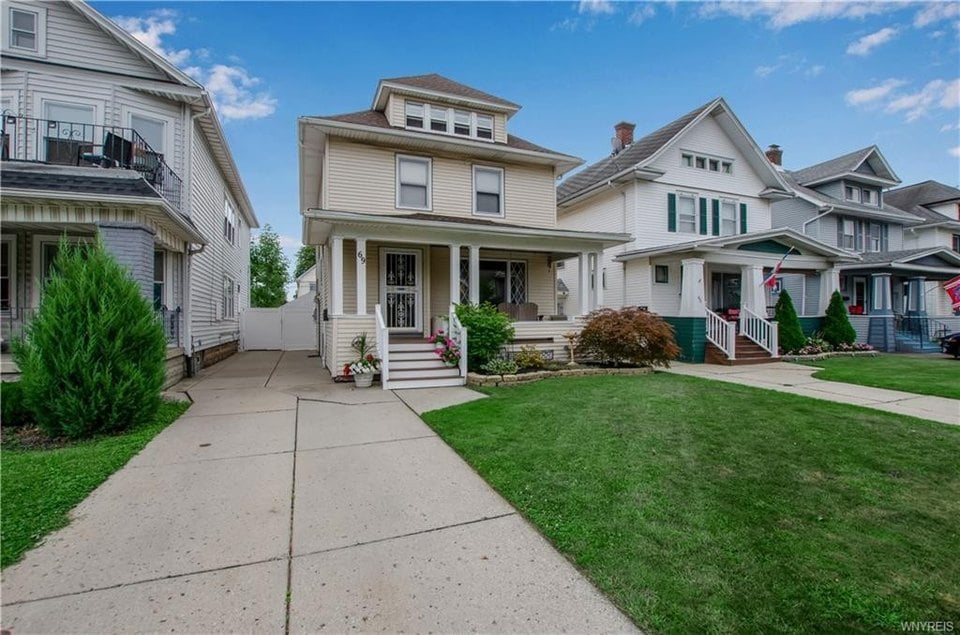
Buffalo has a unique advantage when it comes to house hacking: affordable housing and solid rental demand. Multi-family properties are still within reach for first time buyers and investors alike.
Here is what makes the math work. Solid duplexes in neighborhoods like South Buffalo, Cheektowaga, Kaisertown, Lovejoy, and Lackawanna still sell for $150,000 to $250,000. Rental demand is strong, driven by UB students, young professionals, and workers at ECMC and Buffalo General Hospital. A 2-bedroom unit in most Buffalo neighborhoods rents for $900 to $1,300 per month. And owner-occupied duplexes qualify for FHA loans with just 3.5 percent down, the same as a single-family home.
A Real-World Scenario
Here is how the numbers could pencil out on a $200,000 duplex in South Buffalo or Cheektowaga.
With an FHA down payment of 3.5 percent, you would need about $7,000 upfront. Your monthly mortgage, taxes, and insurance would be around $1,500. Rent from the other unit would bring in $1,000 to $1,200 per month. That leaves you with a monthly housing cost of just $300 to $500.
Compare that to renting in the same Buffalo market for $1,000 to $1,400 per month while building zero equity. The difference is significant.
What You Can Actually Buy Right Now
East Side Affordable Entry Points
109 Poultney Avenue in Buffalo's 14215 zip code is a fully gut-renovated duplex listed at $180,000. Both units are vacant, so you can choose your tenants. Collecting $950 per month from the upper unit brings your monthly living cost close to zero.
27 Moselle Street in Buffalo's 14211 zip code is listed at $122,000. The lower unit is vacant for an owner-occupier, and the upper unit has a tenant. This is a classic Buffalo house hack strategy with built in affordability.
181 Clarence Avenue in Buffalo's 14215 zip code sold for $125,000. The lower unit was rented at $525 per month, providing immediate cash flow, while the upper unit was vacant and ready for renovation. This is an ideal BRRR or house hack candidate.
North Buffalo Turn Key with Strong Rental Income
188 Norwalk Avenue in Buffalo's 14216 zip code is listed at $319,900. This is an excellent opportunity for owner-occupants seeking strong rental income or a house hack opportunity.
508 Linden Avenue in Buffalo's 14216 zip code sold between $249,900 and $299,900. This well-maintained duplex in highly sought after North Buffalo has major capital improvements including a new roof, new central air conditioning, new furnaces, and updated windows. It is located just steps from Hertel Avenue and Delaware Park.
498 Linden Avenue in Buffalo's 14216 zip code is listed at $369,900. This is a beautifully updated side by side duplex in desirable North Buffalo.
High Yield Opportunities
108 Roosevelt Avenue in Buffalo's 14215 zip code is listed at $150,000. This fully occupied duplex has one unit rented at $1,050 per month, with potential gross income of $2,100 per month. The cap rate is over 10 percent. With 5 percent down, your monthly payment would be approximately $1,150. One tenant alone covers the majority.
Financing: How to Get Started
FHA loans are the most powerful tool for house hackers. An FHA loan lets you buy a duplex, triplex, or fourplex with just 3.5 percent down. This is one of the most powerful low capital paths into real estate investing.
Here is how it works. For FHA loans, the lender can use 75 percent of the appraiser's estimated rental value for the units you will not occupy, which helps you qualify for a larger loan. FHA loans cover properties with up to four units. FHA does not finance pure investment properties, so you must plan to live in one of the units.
Other financing options include VA loans with 0 percent down, USDA loans with 0 percent down for eligible rural areas, and conventional loans with 5 percent down for owner-occupied multi-family properties.

Accessory Dwelling Units Another Path to House Hacking
If you are not ready to buy a multi-family property, you might be able to create rental income on your existing property. Buffalo's Unified Development Ordinance, also known as the Green Code, permits accessory dwelling units, or ADUs, in most residential zones.
Key ADU rules in Buffalo include a maximum size of 800 square feet or 33 percent of the primary dwelling, whichever is less. The minimum lot size is 2,500 square feet. Owner occupancy of the primary dwelling is required. One off street parking space is required for the ADU, though this can be waived in walkable districts. Short term rental use is prohibited.
ADUs can be attached, such as an in-law suite or basement apartment, or detached, such as a backyard cottage. Garage conversions are permitted when they meet egress, ceiling height, and insulation requirements.
The Catch: You Are a Landlord Now
House hacking is not passive, at least not at first. You will be responsible for tenant screening, maintenance calls, and being the responsible party. But for someone willing to put in the time, the financial upside in Buffalo's market is very real.
FAQ
Q: What is house hacking and how does it work in Buffalo?
A: House hacking means buying a small multi-family property, living in one unit, and renting out the others. In Buffalo, this can reduce your housing cost to $300 to $500 per month while building equity, and potentially to zero.
Q: Can I use an FHA loan to house hack a duplex in Buffalo?
A: Yes. Owner-occupied duplexes qualify for FHA financing with 3.5 percent down, the same as a single-family home.
Q: Which Buffalo neighborhoods are best for house hacking?
A: Recommended neighborhoods include South Buffalo, Cheektowaga, Kaisertown, Lovejoy, and Lackawanna for strong rental demand and affordable entry prices. North Buffalo offers turn key options with stronger rental income but higher prices.
Q: How much rental income can I expect from a Buffalo duplex?
A: A 2-bedroom unit in most Buffalo neighborhoods rents for $900 to $1,300 per month. Some East Side duplexes can generate $2,100 or more per month in gross rent.
Q: What is the catch with house hacking?
A: You are a landlord now. You will handle tenant screening, maintenance calls, and being the responsible party. It is not passive, at least not at first. But for someone willing to put in the time, the financial upside is significant.
Q: Can I create rental income on my existing home in Buffalo?
A: Yes. Buffalo's Green Code permits accessory dwelling units, or ADUs, in most residential zones. You can add an attached in-law suite, basement apartment, or detached backyard cottage up to 800 square feet.
Q: What are the ADU rules in Buffalo?
A: ADUs must be on lots at least 2,500 square feet, occupy no more than 800 square feet or 33 percent of the primary dwelling, whichever is less, and meet parking and design standards. Owner occupancy of the primary dwelling is required.
Check out this article next